
Painting the Town
November 2025
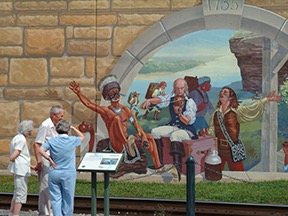
But in the past few years they have popped up like mushrooms. More than 10 dozen Missouri communities have livened up downtown spaces with murals, touting everything from the home of sliced bread to the baby chick capital of the world to the “neatest little town in Missouri.”
The earliest murals still speak to us from caves, where distant ancestors tried their hand at interior decorating. Now, wall art is in full bloom. From Hannibal to St. Joseph and points between, artists have mounted ladders and scaffolds, adorning willing walls with stunning portrayals of local history and culture.
A New York Times reporter visited Cape Girardeau a few years ago. The reporter wasn’t kind, complaining that the drab gray floodwall gave the city a medieval appearance. The wall separated the city from its lifeblood—the river—and discouraged visitors.
Cape Girardeau responded by launching a mural project on that floodwall, a bold artistic feat so stunning that historians will categorize Cape’s history as pre-mural and post-mural. The visuals are that good.
The people of Cape Girardeau embraced their history, their downtown and each other in smacking an artistic grand slam over a 12-foot-tall gray floodwall. And the murals have helped spawn a renaissance throughout downtown Cape Girardeau.
When the city announced a search for the perfect muralist to transform a barren wall, several world-class artists offered their services. Many had impressive credentials. They talked about their muralistic conquests across the globe. They proudly portrayed their portfolios.
Then a visionary young painter named Tom showed up, wearing a cheap suit and a red pork pie hat. Other artists attempted to win Cape’s favor by boasting of their prowess and finesse. Tom took a different approach.
“Who are your characters?” Tom asked. “What is your history?” He courted the town, and the town courted Tom, and they struck a relationship that sank deeper than a coat of paint.
Locals began to recognize him because he always wore that bright red pork pie hat. They spotted him everywhere. Rather than zipping into town for a quick interview and leaving in a whoosh of self-important urgency, Thomas Melvin stuck around. Like a fiddler on the roof, he perched and squatted in every possible spot to perceive the town and its rich fabric.
He talked to the townsfolk, and asked about things that were important to them and to their city. He dined with them at Port Cape Girardeau, a restaurant where, looking out a giant picture window, patrons and New York Times reporters saw an imposing gray floodwall. Tom saw a blank canvas...awaiting.
Now when you sit at a table in front of the big picture window at Port Cape Girardeau with a platter of ribs glazed three times and bathed in smoke, that picture window is bathed in tales of this river community.
Locked Out Again
August 2025
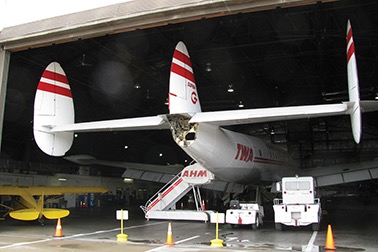
It wasn’t her fault. Connie was sweet and beautiful, her allure too hard to resist. I thought I could get away with it and stop for only a few minutes, if only to gaze upon her beautiful shape.
But my detour to her doorstep brought me deep despair. I paid dearly for my mistake.
Connie stays at Kansas City’s old municipal airport. She’s known more formally as a Lockheed Constellation, the airline workhorse of the 1950s. You’d instantly recognize the plane, with her curvy porpoise fuselage, three tail fins and four propellers—the poster plane for Howard Hughes’ TWA.
She sits in Hangar 9, a museum at the old airport, itself a relic, replaced by the larger, safer Kansas City International Airport. Tucked into a tight river bend beneath the watchful eyes of the Kansas City skyline, this airport museum gets overlooked by just about everybody, one of Kansas City’s best-kept secrets.
On the day we visited the old airport, foul weather had grounded flights. Forecasters predicted tornadoes. So Erifnus, my car, delivered me through the howling wind and rain into the parking lot.
As I climbed out and locked her doors, I realized I’d left the keys in her ignition. I stood, numb, frozen—not from the wind and rain that pelted me, but from my own stupidity.
Erifnus Caitnop doesn’t deserve such rude neglect. She’s performed nearly flawlessly as my Trigger, my Lassie and my Old Faithful all rolled into 140 horsepower. She is my one constant companion along this journey across every mile of every road on Missouri’s highway map, my trusty steed for 15 years and nearly 300,000 miles.
But on this day, she sat protecting my keys from the wind and the rain.
And me.
I must confess that this is not the first time I’ve locked the keys in this car. In fact, I’ve probably tied a world record: performing this stupid feat twice in one day. That memory is painful. At the end of that horrible day I promised Erifnus I’d never again treat her with such neglect.
But over the years, as with most partnerships, there were stressful moments. Most were caused by driver error. Spinouts. Warning tickets. Getting stuck in mud. Sliding sideways under downed power lines. Stuff like that.
And now this.
I regained my composure and entered the museum hangar, confessing my stupidity to the friendly folks inside. They were extremely helpful, being pilots and mechanics and classic airplane lovers.
But try as we did, we couldn’t make a coat hanger unlock my car.
So after a tour of the museum and a walk down the aisle of that classic old aircraft with its three tail fins and four engines and porpoise-shaped fuselage—and $90 for a locksmith—I thanked my hosts, said farewell to Connie, tucked my tail fin in the driver’s seat, and drove home.
My Favorite Road
May 2025
You Want Wisdom With That?
February 2025
From experience, I knew to honor the seating chart. The seating chart is not posted on the wall or the cash register or in the manager’s office. It’s in the habits of the seniors who come here every weekday at the same time and sit with the same friends in the same chairs at the same table.
Folks were eager to tell me about Ellington, stuff you might not hear at the Reynolds County Museum down the street. Robert, an affable chap at a table within earshot, told me about the industry in town. Boats and saws, mainly, reflecting the area’s predominant natural resources.
“If you’re going past Lake Wappapello, don’t miss Bullwinkle’s. You’ll find out about the airplane,” Robert laughed.
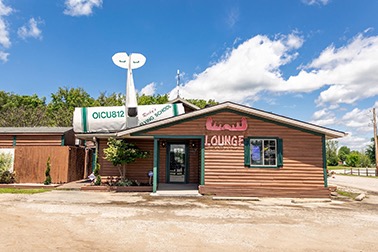
I thanked my hosts and left the warm security of the senior center for the surprises of the road, including Bullwinkle’s Bar with an airplane crashed straight down into the top of the roof. It was rigged, of course, but an effective attention getter.
To get to Bullwinkle’s we crossed the Castor River, crossed the Castor River again, crossed it again, and again and again. We crossed the Castor River so many times that I stopped to study my map. Turns out there are two Castor Rivers, at one point flowing within five miles of each other. Apparently, when engineers drained all this swampland, one Castor River became two.
Castor is French for beaver, and the beavers built dams all through this swampy region. Despite being the hardest working hydraulic engineers on the planet, beavers don’t get a paycheck, so they have a right to be the namesake of multiple waterways.
Henry Schoolcraft, the first chronicler of the Ozarks, had another name for the Castor. He called it Crooked Creek. It’s a simple name. One can understand why he preferred simple names. His wife’s name was Obabaamwewegiizhigokwe, which in her native Ojibwe language means “the sound that the stars make as they rush across the sky.” Henry called her Jane, which means “Jane.” I think I know why. Her mother, Ozhaguscodaywayquay, probably didn’t object, since she herself adopted the Anglo name Susan Johnson.
Despite his prominence in exploring Missouri’s Ozarks, I have yet to drive past a sign or a town or any place named Schoolcraft. He’s in good company, though, since there isn’t a Moses, Missouri or an Austin either. There’s no town named Yogi in Missouri, although there is a Jellystone Park. There’s no Shapley, no Blow, no Dice, no Wilder, no Sacagawea or Calamity. Ah, but there’s a Jane.
And Bullwinkle’s.